Thomas (Pop) Maloney
THOMAS (Pop) MALONEY
10.07.1890 – 07.01.1959
Written by C F Maloney.

Thomas in 1895
Thomas Maloney was born at 16.30 hours on Thursday 10 July 1890, at 30 William Street, Hulme, Manchester, Lancashire. He had a lot of black hair and brown eyes he was named after his father. Thomas senior worked in Manchester as a boiler coverer. His mother, Jane Maloney, formerly Jane Marchant, born in Kidderminster, was 18 years old at the time.
The family moved shortly after young Thomas was born, they went to lodge at number 24 Carlisle Street, Hulme, Manchester. They lived there when the census was taken in 1891 Thomas was 9 months old at the time. I presume they moved to Carlisle Street so that Jane could be near her mother, Emma Elliott, formerly Emma Marchant, nee Hilton, who lived at number 18 Carlisle Street, with Thomas Elliott and her daughters Alice and Amelia like Jane they were by Emma's first husband, John Marchant. On the 1891 census Emma, Alice and Amelia’s surname name is shown as Elliott, which was wrong. (Look at census 1881 for 26 Back Queen Street, Kidderminster) The houses in Carlisle Street had cold running water, but no hot water. In the cellar they had a bricked boiler, heated by coal or coke fire to do the laundry. The houses had two bedrooms upstairs, two rooms downstairs, a small scullery, a cellar and a small back yard with an outside toilet. The heating in the house was a coal fire in the living room and a small fire- place in the front room, which was very rarely lit when they were short of money; they heated the place by coke or wood fire. The lighting was by gaslight. In order to obtain a supply of gas, they had to put money (pennies) in the gas meter, which was in the cellar. Jane, her husband and young Thomas moved again into a house of their own. It was only a short distance to number 1 Overton Street, Hulme. There, on 24 April 1892, William Maloney was born, a younger brother for Thomas.
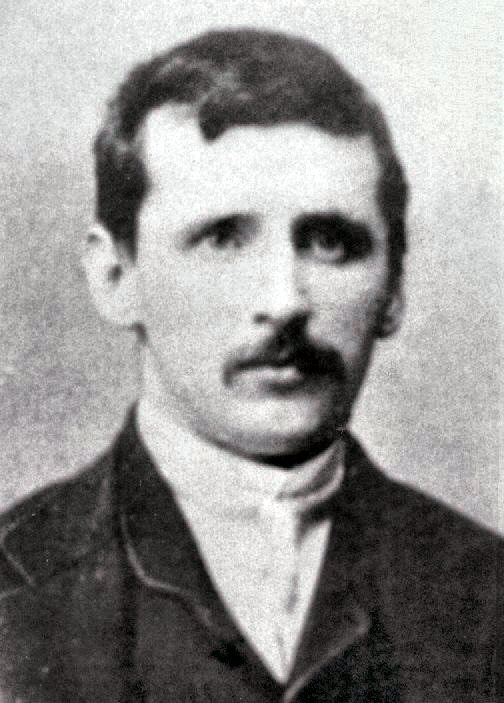
Thomas Maloney Senior.
Twelve months later in 1893, Thomas senior died, leaving his
wife Jane, with no income and two very young children to care for. This made
life very hard for her; in those days there was no Social Security. She could
not go out to work and leave the children, so she started taking in washing to
earn some money. Her mother was prepared to help, but unfortunately her own
financial position was not very good. Her family of four were living on her
husband's pay as an ostler, which did not amount to much in 1893. She had
already taken in lodgers to help pay the rent.
The death of her husband had made life very difficult for Jane, and it was made even more so because her husband had been of Irish descent and, we presume, Catholic. She was Church of England and they had been married in a Protestant church. When he found out about the death of Thomas, the local catholic priest kept going round to her house. At first suggesting she let the children go into a catholic home, because of her poor circumstance. She refused. The visits became more frequent and sometimes two priests would go to the house, harassing her. Jane was young vulnerable and very worried especially when they started to threaten to take the children away from her. Eventually she could not stand their constant harassment any longer so she decided to pack her belongings and left Overton Street. I was told she went to stay with relations in Kidderminster where she was born. Things did not work out hence her stay in Kidderminster was short lived and she moved back to Manchester. She found accommodation at number 7 Brunswick Street where she found work as a housekeeper and was able to keep baby William with her. In order to help Jane, her mother, Emma, with the approval of her husband Thomas Elliott, said they would have young Thomas to live with them. It was agreed that they would change his name to Thomas Elliott, and bring him up as theirs. This was to avoid any further trouble with the priest.
Living at number 1 Brunswick Street was a bachelor, Thomas Adcock, a carriage builder by trade, who had moved to Manchester from Long Eaton, Nottingham. Jane met Thomas Adcock and after a short courtship they married on the 15 December 1894 at the Parish Church of Saint Michael, Hulme, Manchester.
Young Thomas grew up with his Grandma and Granddad. When he talked about them in later years it was always with great affection and he always called them Grandma and Granddad, although Thomas Elliott was not his real Granddad. When Thomas was old enough he started school at nearby Mulberry Street. He was a very keen pupil and did not like having a day off even when he was not feeling well. In 1903 he got a certificate for not having any time off during the previous year.
Thomas Elliott senior had been an ostler in the horse tram stables but later he became a driver on the horse trams, so during the school holidays, and sometimes on summer evenings, Young Thomas, by arrangement, used to meet his Granddad's tram, and take him a meal and a can of tea. (A special can for tea, the lid was also a cup with a handle - they were nearly always dark blue in colour outside and white inside.) One of the meals Tom used to take to his Granddad on cold winter days was a basin of sheep's head broth. (Pop said it was a cheap, warming meal and his Grandma used to make it really nice.) Young Thomas used to enjoy a ride on the trams with his Granddad.
In 1904, at the age of 14 Thomas left school. Work was not easy to get, and in the next few years he did various jobs; anything to earn money for his Grandma. One place where Thomas and his friends used to go for casual work was London Road Goods Station. They would stand outside the gate about 10.00 o'clock at night. The foreman would come out and tell them how many extra men he required to make up the staff for that night. Then he would pick them - "You, you and you". Always the strongest men and the best workers that he had employed previously were chosen. It was hard work and involved moving heavy goods, with the aid of hand trucks, from the railway wagons to the road vehicles.
In 1908, when Thomas was 18 years old he was taken on the permanent staff at the London Midland and Scottish Railway Company, London Road, Manchester. He started work on night duty in the goods department, and throughout his railway career, he worked at night in anything but ideal conditions. London Road Goods Station was situated under London Road Passenger Station. (Many years later it became Piccadilly Station). The railway arches where the goods staff worked were under cover, but opened to the elements at both ends, the top of the arches were approximately 20 feet high. The wind used to whistle through the unheated arches, especially in winter, chilling one to the bone.
Thomas and his brother William always kept in touch. They
were good pals and used to go about together, even though Tom lived with his
grandparents and Billy lived quite a distance away with his mother, stepfather
Tom Adcock and his half-brothers and sister, Arthur, George, Ernest and Edith.
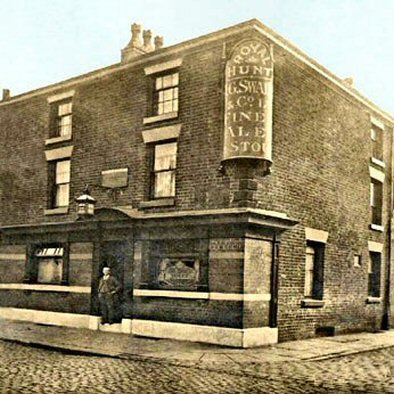
The Royal Hunt 1912 - William Grant stood at the door.
One of the places Tom would go to at the weekend for a drink was a local public house, the "Royal Hunt" in Trafford Street, Hulme. Early in 1912 the "Royal Hunt" public house changed hands. The new landlord was Mr William W(R) Grant (age 60) and his family. They were his wife Sarah Mary (Polly) (47), their son George (28) and their daughters May (23), Ada (21), Florence (Florrie) (17), Ethel (15) and Marie (11).
Tom and Florrie very soon started going out together. That is, they went out on the one or two evenings a week that her father would allow her. Even then she had to be home by eight or nine o'clock' he was very strict. During the day Florrie worked for her parents in the pub. Using the excuse of her mother's errands, she used to meet Thomas, sometimes in the mornings when he was on his way home from night work.
Copyright
© Keith Maloney 2010 - 2022