Thomas (Pop) Maloney
Nineteen Twelve was a somewhat eventful year. On 1 March 1912 one million coal miners withdrew their labour in the industry's first strike. They wanted a minimum wage of 5 shillings (25p) per day for every man who worked underground.
On the 14 April 1912, the unsinkable ship Titanic hit an iceberg and sank off Newfoundland, 1,516 people died.
On the 15 April 1912 Billy joined the Territorial Army. This was a military force established in 1907. They were also called part-time soldiers because, unlike the regular army, they only paraded once or twice a week, in the evening and occasionally at weekends. They also went to a summer camp for two weeks each year for training. Billy became No. 350008 Private William Adcock. Shortly afterwards Thomas also joined the R.A.M.C. (TA) 1/1st Field Ambulance, 42nd East Lancashire Division, Upper Chorlton Road, Manchester. Thomas became No. 350154 Private Thomas Elliott (TA).
Time passed by - 1912, 1913 - by the middle of 1914, Florrie and Tom were talking of marriage. Tom's grandparents, Emma and Thomas Elliott had removed from Carlisle Street and were living at 181 Warde Street, Hulme. Florrie's parents were moving from the "Royal Hunt" (which sold Swales Beer) to another public house, the "Beehive Inn" at 3(a) Kempster Street, Lower Broughton, Salford.
About this time, rumour of war was the topic of conversation everywhere, especially in the pubs. Tom and Billy were spending more time at the Drill Hall with the territorial army in Upper Chorlton Road, training.
In July 1914 Austria attacked Serbia following the murder of the Archduke Ferdinand. Russia came to the aid of Serbia and Germany to that of Austria. It was about this time that Tom and Billy were called up with the Territorial Army. They spent a few days at the Drill Hall in Upper Chorlton Road, sleeping on the floor at night. They were then moved to an army camp at Turton, near Bolton where they were housed in "Bell Tents". These were large round tents with a central pole, the canvas stretched over the pole, it looked like a canvas bell. A lot of men could sleep in one, because of its shape. They each slept with their feet to the pole. The tents were in fields and it was very muddy when it rained. They were not there long when Germany and Austria declared war on France, as Russia's ally.
The invasion of Belgium brought Great Britain into the war in August 1914.
Life at Turton camp became hectic from early morning until night, with very little time off. The soldiers of the 42nd East Lancashire Division knew now they would soon be going abroad. All their stores and equipment had to be got ready. They had a medical examination and numerous inoculations. They had lectures on various subjects as well as their usual training schedule for their army job. Most important in order to keep fit, there were daily physical exercises.
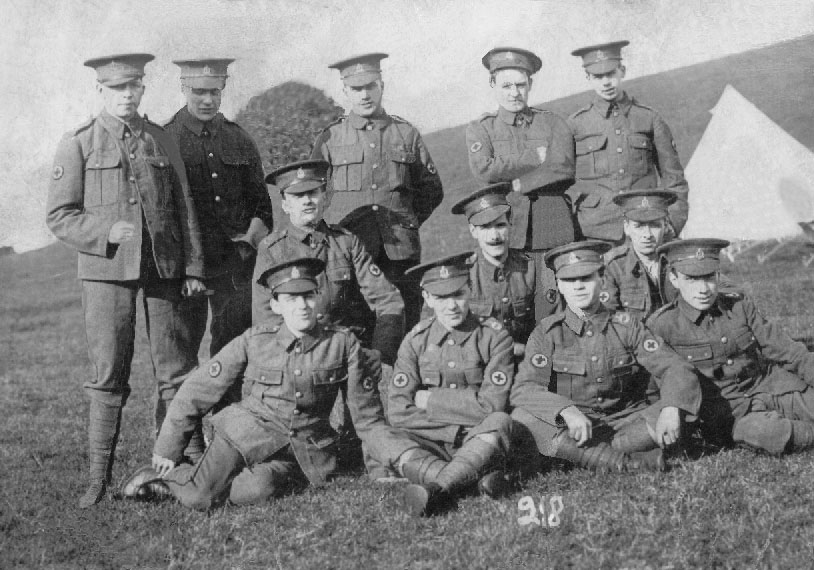
RAMC Turton Camp August 1914
Tom and Billy knew there was every possibility they would be separated sooner or later, and sent to different destinations. However, there was a regulation in the British Army at that time which allowed an older brother to claim a younger brother, and have him stationed with him. Thomas took advantage of the regulation and put in an application to have William with him. They were sent for and asked to explain why, if they were brothers, they had different surnames Elliott and Maloney? They explained the circumstances and why their surnames had been changed. It was pointed out to them that, in order to agree to the application, it would be better if they reverted to their registered name, Maloney, while they were in the army. This would avoid any misunderstanding at a later date, perhaps under a different administration. They agreed, and the application was granted. (Tom and Billy remained together throughout the war apart from when Billy went into hospital)
Although Turton was not far from Manchester, Florrie and Tom
were only able to meet for a couple of hours on the few occasions Tom was
allowed out of camp. However, Tom got permission from the army to get married
and leave was granted accordingly. One afternoon he was given time off to go
and make the necessary arrangements to get married by special license. It was
while they were on the way to get the license that Tom told Florrie his name
was not Thomas Elliott, but Thomas Maloney! Having changed his name in the
army, he thought it best to change his name back to Maloney altogether. Florrie
was surprised she had no idea until then that his name was Maloney. When he
explained the circumstances she understood and said it did not matter. The
marriage was arranged to take place at the Parish Church of St Paul, Stretford
Road, where Tom had attended Sunday School has a youngster, Mother also said he
was christened there. Thomas arranged his leave, and the wedding took place;
Monday 17 August 1914, witnessed by her Father William W Grant, May Grant and a
few friends. While Thomas was on leave they spent the time at his Grandma and
Granddad's, 181 Warde Street.
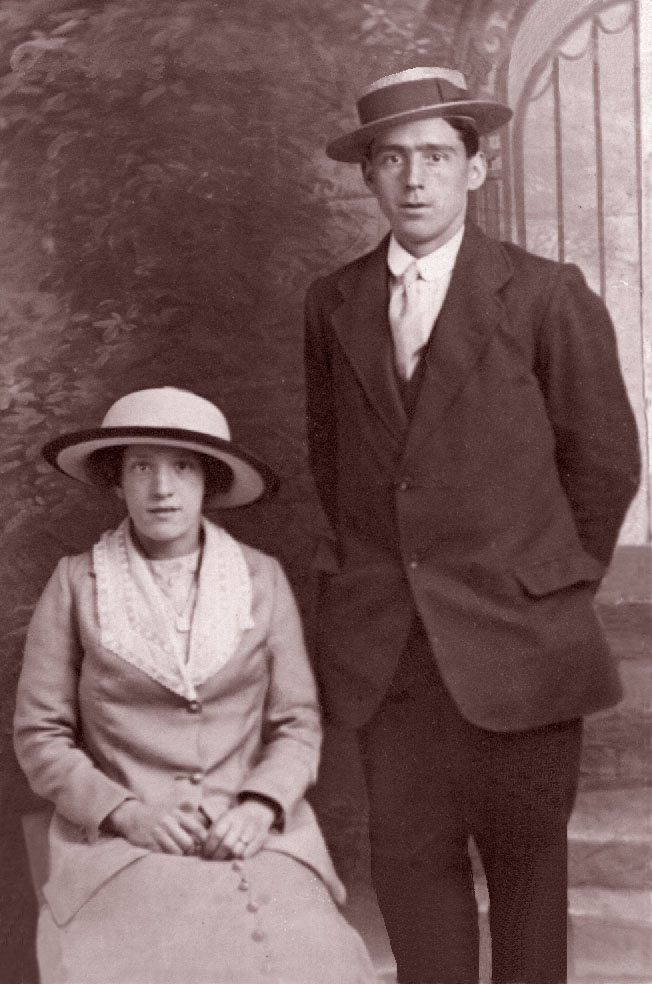
Nana and Pop's Wedding Day 17th August 1914.
When Tom went back to Turton Camp, Florrie went back home to live with her parents until Tom would return from the army. Florrie's parents were by this time living at the "Beehive Inn", Lower Broughton Salford. When Tom returned to camp they only met once before he went abroad. Early in September rumours got around the camp that they would be going overseas any day. Tom wrote and told Florrie. He also told her not to worry, but she decided she wanted to see him once more before he went. She got a train to Bolton. She had no idea where the camp was and had to keep asking directions. Then she met some soldiers who were going back to camp, they said she could go with them. When they got to the camp, they went in and found Tom and brought him out to her. They only had a short time together, he had to go back into camp and Florrie had to make her way home. However, she was very pleased to have seen him because Tom left Turton a few days later.
The 42nd East Lancashire Division left Turton camp at 12.30 hours on the 9 September 1914. They arrived at Southampton Docks at 15.30 hours on 10 September. The men lounged about on the platform until 18.00 hours. Then they embarked on RMS Aragon. The ship sailed at 23.00 hours that night. They had no idea where they were going.
Very few of the men from the 1/1st Field Ambulance had been on a ship before they embarked on RMS (Royal Mail Steamer) Aragon, certainly Thomas and William had not. When they first arrived on board they were allocated a place to sleep, and given a life belt, which they were told they must carry with them at all times while aboard. Before turning in for the night, they went up on deck to have a look round. It was very dark and they could not see much, however, they could just make out the shape of one naval vessel that was accompanying them. They were enjoying their new experience as RMS Aragon steamed up the English Channel in the darkness. By morning they were well out into the Atlantic Ocean. A sailor told them they were on the fringe of the Bay of Biscay, and the swell they could feel was that of the famous bay. He said in rough weather that is what made people sick. The ship steamed on out of sight of land, nothing but sea to the horizon. It was rather choppy and the ship rolled quite a bit, making some of the men feel queasy. Tom however felt fine; he enjoyed the fresh air, up on deck. Each man had been detailed to either a lifeboat or raft, in case of an emergency. At various times they had a practice alarm; the alarm signal was short sharp blasts on the ship's siren. On hearing this, the men had to go quickly to their boat or raft.
They passed Portugal, out of sight of land and eventually entered the Straits of Gibraltar. When they passed the rock, the ship's speed was reduced, and a naval launch came alongside. When the launch left it was full speed ahead into the Mediterranean Sea. The journey took them passed Morocco and Algeria on the starboard side of the ship. Most of the time they were in sight of land. During the day, sailing along the North African coast, the boys could plainly see the hilly country and white buildings shining in the sunlight. For them the war had not really started. They were enjoying a cruise in the truly blue Mediterranean. They had nothing much to do in the way of duties, so to pass the time, they either wrote letters, read books, played cards or played gambling games. Crown and Anchor and Housey-Housey (Bingo) were two of their favourites. In the evenings they enjoyed singing popular songs.
Next day the ship's course was altered and it moved away from the North African coast. They were soon out of sight of land. Leaning over the ship's rail, Tom saw some porpoises swimming alongside, escorting them on their way. It was not very long before land was seen in the distance. They sailors said it was Malta and that the ship would be calling there. News that land had been sighted soon went round the ship. Crown and Anchor and the card games were abandoned and the lads rushed on deck to have a look. A destroyer came out to meet them, and to guide the ship into the harbour, among the many ships and naval warships already there. As soon as the anchor was dropped the ship was besieged by small boats, loaded with fruit and cigarettes etc, the Maltese wanted the soldiers to buy. They threw a rope line up to the deck, to which was attached a basket, the lads catching the line and doing trade by winding the basket up and down. Nearby some small boys were diving into the water to retrieve coins thrown in by soldiers on the ship's deck. The visit to Malta harbour was a short one and the troops were not allowed off the ship.
RMS Aragon sailed slowly out of the harbour, with the chaps lining the rails to have a last look at Malta. Some of the troops on other ships, and sailors on the warships cheered and waved to them. It was not long before they were once more going full speed ahead into the blue Mediterranean Sea. They had been told when they left England that they were going to the Middle East. Now they were told their destination in the Middle East was Alexandria in Egypt. This information cheered them up, and they looked forward to fine weather and sunshine; it would be like a holiday for the Manchester lads. It must be remembered, in 1914, these Lancashire workingmen would certainly not have been able to afford a holiday in Egypt. Their holiday was more likely to be have been a day at the seaside, most probably Blackpool, if they were lucky. Next day the weather was beautiful and the sea calm. Tom and his pals spent some time leaning on the ship's rail watching the flying fish skim over the blue sea, to suddenly disappear into a wave caused by the wash from the ship's bow. At night they watched the larger fish swim near the ship, their phosphorous bodies with a greenish glow showing up plainly in the dark sea. The rest of the journey was pleasantly spent and passed quickly. Tom and his pals were excited and curious as the ship entered the harbour at Alexandria. From the docks, they went to a camp at Ras-el-Tin, part of which was under canvas. There they were given blankets, palliasse and allocated to a tent. The bell tents were in neat rows, 15 men to each tent.
The Suffolk Regiment was also stationed at Ras-el-Tin. The Lancashire lads thought the Suffolk’s were very smart soldiers and they soon made friends with them.
There was a military hospital at Ras-el-Tin where some of the 1st Field Ambulance men were sent to work, and some for further training. Tom, being a corporal, was sent to the hospital for special training. Later, it would be his job to train the men how to do the various work. One of the jobs he was trained to do was the preparation of bodies for a post-mortem and to lay out the instruments that would be needed by the surgeon. He had to assist the surgeon during the operation and clear up afterwards; this entailed putting pieces back that had been removed for examination and preparing the corpse for burial. He said he was amazed when he first saw the instruments used for this type of work. The men who were not sent to the Hospital were allocated to various jobs around the camp. Billy got the job of collecting the rations for the camp. Any job connected with food, Billy enjoyed. After duties the men made their own fun. In William's own words, the weather was "gloriously fine", ideal for swimming in the sea, which they did most days. They played football and occasionally arranged matches with other units. During daylight they played cricket and took part in other outdoor sports. Nearly every evening there was a good old singsong in the canteen. Now and again some of the boys would get together and arrange a concert. It was easy in those days to get a concert party together. At home, the people made their own entertainment; most homes had a piano or organ as well as other instruments. In the evenings they would all gather round the piano and sing. Then they would do their own party piece. Consequently the army had a considerable number of artistes to call on to give concerts. There were vocalists of every description from bass to tenor. Musicians to play any instrument, including many pianists, organists, violinists, banjoists and all the brass instruments. Other performers including comedians, jugglers, magicians, acrobats, clowns, impersonators, tap-dancers, many comics who specialised in monologues and not forgetting those that played the saw and the spoons. The artists who were good and whose performance other solders enjoyed were given rapturous applause. Those that failed to please the audience were left in no doubt - they were booed and given their marching orders, sometimes with the odd missile - like a ripe tomato.
The Lancashire lads - with very little knowledge of foreign countries, found the Egyptians and their customs rather strange at first. Billy said, "The natives to us, were very funny", and it's "A bit of a devil, getting used to ‘Gypoe’ money". During September and October the weather was fine, warm, dry and plenty of sunshine. Tom said the lads had plenty to occupy them and they were making the best of the situation and enjoying it. During October they got news from the Western front of a battle going on for the Belgium town of Ypres. In November it was rumoured that the Turkish troops were advancing towards the Suez Canal. Forty men from the 1st Field Ambulance Section, including Tom and Billy, were detailed to go on active service to the area. Their destination was Ismailia, a town of lower Egypt situated on Lake Timsah. It is about halfway between Port Said and the town of Suez, on the Suez Canal. Ismailia is 93 miles by rail from Cairo. It was established during the construction of the Suez Canal. During the war it became an important headquarters of the Allies. On arrival, the field Ambulance Section were billeted in an old French chateau. The quartermaster had not issued them with cooking utensils when they left Ras-el-tin. Billy, who had been detailed as mess cook, promptly obtained some, belonging to the Frenchman who owned the chateau. The Frenchman was not in residence at the time the chateau was being looked after by an Egyptian caretaker. When he found out Billy was using their equipment and water supply, he locked part of the chateau so they could not get in. This meant Billy had no alternative but to do the cooking in the yard, which was shared by a cafe. One of the chaps, Sam Bennett, got them permission for a water supply. One night some officers got Billy and Cpl. Bagshaw drunk on port wine, in the cafe.
Towards the end of November 1914, they were moved to an outpost at Kantara, this was 20 miles from Ismailia. Their camp was in a park with beautiful scenery, again they were billeted in tents. Billy was appointed mess cook; or did he volunteer? Whatever, I am sure he enjoyed the work. One day for breakfast, he gave the men plenty of burgue (porridge), 3 eggs, bread, butter and tea. After their dinner of meat, beans and potatoes, he gave them rice pudding with 15 eggs in it. Part of his job was to collect rations for the Section. He used to take one of the Egyptian civilian workers they called Black Jack, with him to assist. One particular day Billy got rather intoxicated on cognac on his way back to camp, he nearly ran over Colonel Beach and Captain Douglas. While they were stationed at Kantara, Tom and his pals used to go swimming in the Suez Canal when they were off duty. One free afternoon the 1st Field Ambulance unit arranged a football match with the Ismailia Town Football Club. They beat Ismailia 7-0. After the game the Lancashire lads became very friendly with the Gurkha's who had come to watch the match.
Early in December 1914 the Turkish push towards the Suez Canal had petered out. Tom and a small detachment were sent to Cairo on a special training course. The remainder of the Section were ordered back to Ras-el-Tin, where once back in their base camp, they started a tough training programme. This included a 30-mile route march, which Billy and his pal Chisel found very hard. After the first 15 miles they were both jaded, with sweat pouring from them. When they got back to camp, they were just about all in, but they managed to march smartly into camp. After a wash, a good dinner, and a short rest, it was into the canteen to have a good time. By the time they left, the route march was forgotten and all were happy again. The usual football matches were arranged - they were never too tired to play football.
Tom and his detachment arrived back from Cairo in time for Christmas. St Marks Church Committee sent the Ambulance Section 33 turkeys - all alive - for their Christmas dinner. Christmas Eve Billy and his pal Chisel got the job of killing and cooking them. Christmas Day all the men received a Christmas card from St Marks. At dinner they all sat down to an excellent meal, served by the officers, who waited on them, providing beer, ginger beer, cigarettes etc. At 1400 hours they all went back to work. In the evening they had a grand concert.
On New Year's Eve they made a fire and put logs on it and waited - listening for the ships' bells ringing in the New Year. Then they waited until 0200 hours, when it would be New Year's Day in Blighty - then they started to celebrate.